The universal data bridge that is FLAM
Data is always flowing, whether from a mainframe (FB/VB) to a cloud system or to the open world, from XML format to CSV, JSON, or from SWIFT to SEPA. But different platforms, formats, and applications rarely speak the same language.
This is exactly where FLAM comes in: we create a neutral, secure, and efficient connection between different data worlds: without media breaks, without information loss, without security gaps.
Whether migration, integration, or long-term archiving, with FLAM your data remains understandable, accessible, and protected: on all systems, in every structure, for decades to come.
THE CONTENT REMAINS THE SAME – ONLY THE FORM IS DIFFERENT.
What began as an archive format for mainframe computers now connects old and new IT worlds. In the new FLAM5 infrastructure, FLAMFILE has become a file system that can be used for different platforms. It is the basis for secure, compact, and standard-compliant data exchange.
Once data from FLAMFILE has been neutralized, structured, compressed, and encrypted, it can be converted into any format and made available.
The Content stays the same - only the form is different.
What began as an archive format for mainframe computers now connects old and new IT worlds. In the new FLAM5 infrastructure, FLAMFILE has become a file system that can be used for different platforms. It is the basis for secure, compact, and standard-compliant data exchange.
Once data from FLAMFILE has been neutralized, structured, compressed, and encrypted, it can be converted into any format and made available.
Understanding, Unifying, Transforming
From original formats to a neutral matrix.
FLAM analyzes and understands a wide variety of data sources.
The content is automatically converted into a structured, neutralized intermediate form that functions independently
of the original format.
EFFICIENT PROCESSING - MEMORY-TO-MEMORY
Minimal resource consumption with linear and predictable runtimes.
While other solutions rely on memory-hungry Java stacks, FLAM is based on C99. This enables true memory-to-memory conversion: data is processed directly in memory without being stored on disk. Resource consumption per transaction is linear, enabling stable and continuous production.
SPEAKING FORMATS FOR HUMANS & MACHINES
Reduces implementation effort, increases security and control.
Unlike formal standards such as XSD or DFDL, which only machines understand, the format description in FLAM is understandable, readable, and maintainable—even without developer knowledge.
The logic behind the data structure can be described and customized. This allows specialist departments to actively participate in the design process.
SEAMLESS INTEGRATION INTO ANY INFRASTRUCTURE
Can be used from PCs to hosts to the cloud, with end-to-end encryption and access control.
Thanks to open APIs, subsystems, and the command line, FLAM can be integrated directly into existing processes. This allows processes to be automated and executed securely, even in regulated environments.
UNDERSTANDing DATA. CONNECTing FORMATS.
FLAM breaks down every data source into its logical building blocks:
- Formats, character sets, and structures are automatically identified—even with mixed formats.
- Contents are transferred to a platform-independent, structured intermediate form.
- High-performance algorithms compress the data and encrypt it segment by segment.
- Any target formats can be generated from this neutral matrix, without media discontinuity or data loss.
The result:
A consistently secure data flow from the mainframe to the cloud, from legacy formats to modern API standards.
APPLICATION CASES FROM PRACTICE
FLAM proves its strengths wherever heterogeneous data structures need to be standardized and reliably transferred. Whether in banking, government, or industry: our customers face complex integration tasks every day, which they can solve with FLAM.
FINANCE
SEPA ↔ SWIFT ↔ Legacy formats
Different XML dialects (SEPA, SWIFT, ISO 20022) are generated from a common database. FLAM ensures format-accurate transformation without media discontinuity, audit-proof and compliant.
Legacy IT
UTF-8 ↔ EBCDIC / FB-VB ↔ CSV, XML, JSON
Classic host formats such as EBCDIC strings and BSD numbers from FB/VB records are automatically recognized, neutralized, and exported as CSV, JSON, or XML, for example. FLAM preserves the logical structure and integrity.
Industry & Cloud
JSON ↔ XML ↔ CSV
Parts lists, machine logs, or IoT measurement data are automatically transferred from production to cloud-based analysis platforms.
Secure, encrypted, and in the correct format.
FLAM vs. XSD/DFDL
While XSD-based systems or the Data Format Definition Language (DFDL) focus heavily on formality and technical depth, FLAM pursues efficiency, comprehensibility, and true interoperability.
THE INFRASTRUCTURE BEHIND FLAM
FLAM is much more than a conversion tool. It is a modular data platform based on decades of expertise in cryptography, data compression, and cross-system interoperability. FLAM technology combines maximum security with outstanding performance in batch, cloud, and real-time environments.
PLATFORM DIVERSITY
FLAM runs on more than 60 platforms: from z/OS, Windows, Linux, AIX, HP-UX to modern cloud deployments (Docker, Kubernetes, OpenShift).
Whether legacy system or microservice, FLAM adapts to your environment.
OPEN APIS & INTERFACES
FLAM offers interfaces at all levels:
- Languages: C/C++, COBOL, PL1, Java
- Tools: Shell, REST, FLCL (command line)
- Systems: z/OS subsystem, file system mount, plug-ins for third-party systems
FORMAT MATRIX
FLAM consistently separates physical representation (e.g., CSV, XML, JSON) from the logical structure (e.g., transaction record, address, amount).
This enables automatic format recognition, simultaneous processing of multiple formats in a single file, and future-proof expandability.
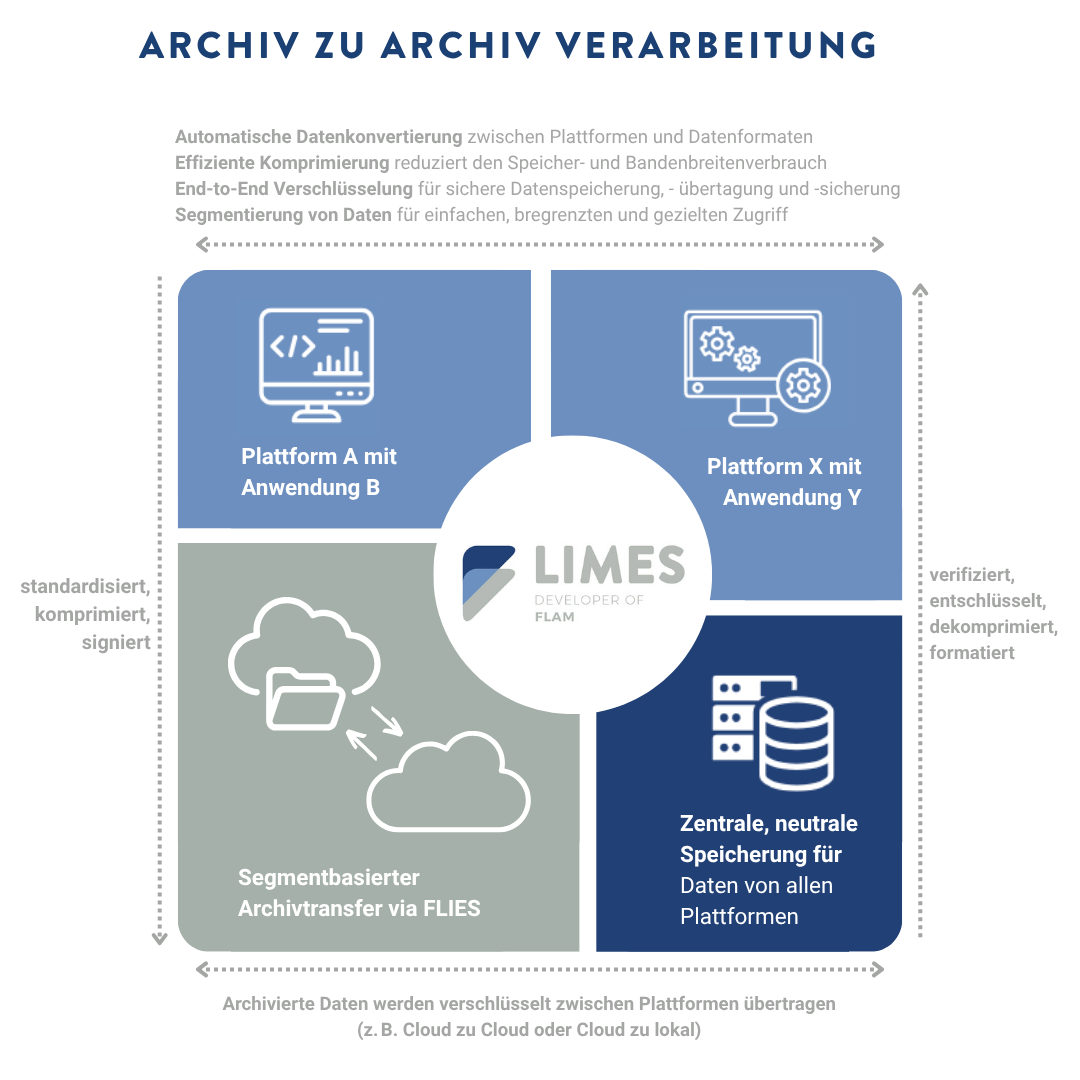
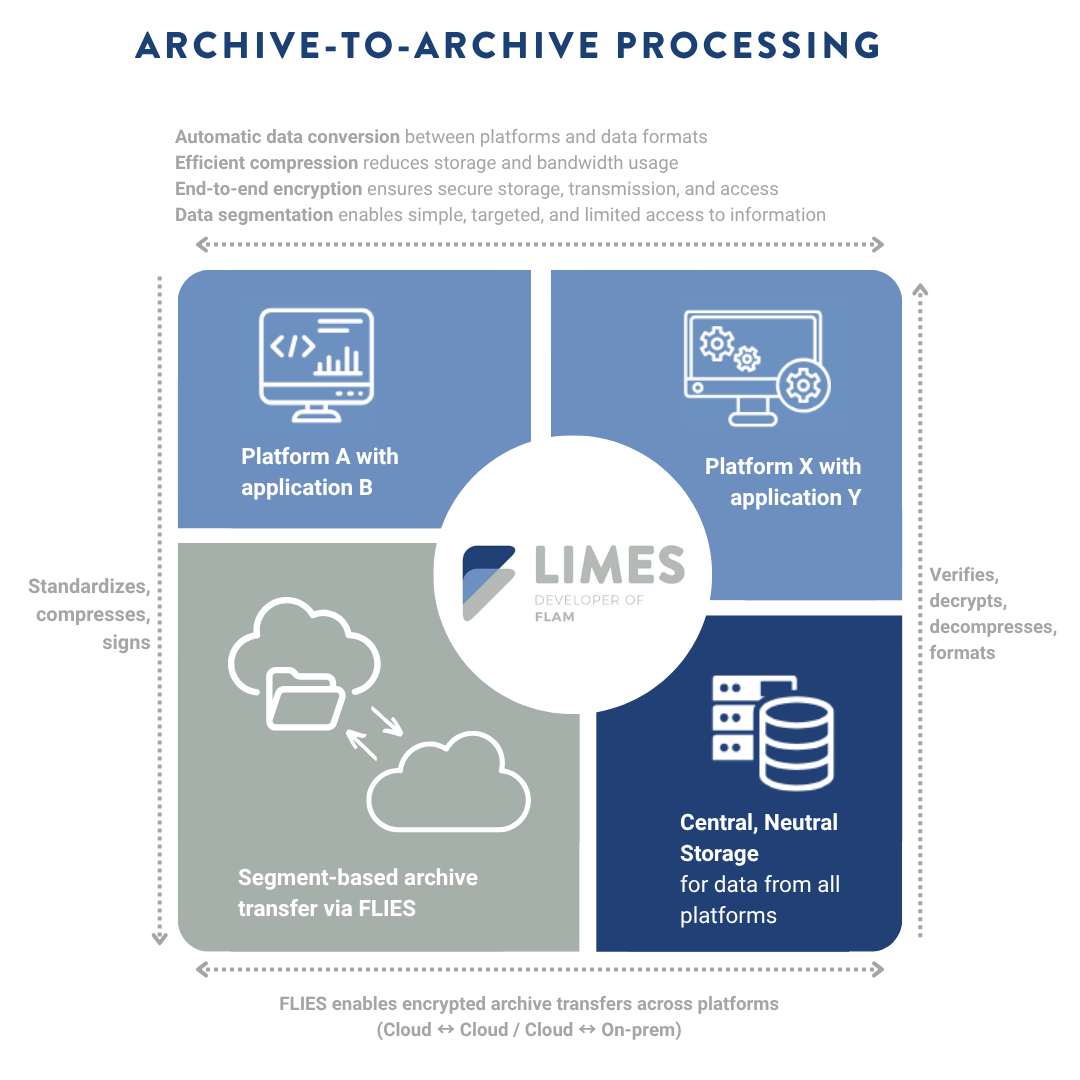
ARCHIVE PROCESSING
Data protection, efficiency, and scalability
FLAM5 archives are more than just storage containers: they consist of compressed and encrypted segments that can be partially read, selectively extracted, or even transformed without completely decrypting a member/file. In addition to indexing the data, the archives are incrementally designed, where each change leads to a new version and thus no information is lost over time.
IT DOESN'T ALWAYS HAVE TO BE AN ARCHIVE
FLAM provides two powerful ways to transform data:
- FLAM (archive): For secure, structured, and long-term archiving
- FLUC (converter): For direct conversion in the process without storage
Different approaches are available depending on your goal. The following overview will help you make your selection:
YOUR SYSTEMS DON'T SPEAK THE SAME LANGUAGE?
FLAM brings order and clarity to your data landscape.
Let's work together to find out how we can connect your data worlds.