Archivieren. Suchen. Bearbeiten.
THE FLAM DATA ARCHIVE
With FLAM, you can manage mass data efficiently, securely, and flexibly in highly compressed, self-sufficiently encrypted, and fully signed archives.
Access like in a database. Storage requirements like in an archive.
FLAM IS NOT A TRADITIONAL ARCHIVE
It is much more than that. In conventional archives, your data is “sealed in.” With FLAM, it remains alive. That's because FLAM is designed for selective, targeted access to mass data—not for black box archiving.
DATA ARCHIVE WITH FULL ACCESS
Forget black box archives. With FLAM, you retain control and actively work with your archived data.
ACCESS TO INDIVIDUAL CONTENT
Search specifically in encrypted, compressed archives.
You don't have to unpack them. Full-text search, wildcards, and filters also work with encrypted data.
ADD, CHANGE, DELETE DATA
Add, update, or remove individual data records directly in the archive. There is no rebuilding, no restoration, and no detours via temporary plain text files.
INTELLIGENT SEGMENTATION
FLAM stores information in individual data blocks that can be decrypted and read independently of each other. This saves resources and increases security.
STABLE PERFORMANCE FOR ANY DATA VOLUME
Even with very large archives, access times and system load remain at a consistently low level. This means that data remains quickly available even with terabyte volumes.
SECURITY AND EFFICIENCY
With FLAM, you can comprehensively protect your data while reducing storage and operating costs.
HIGH COMPRESSION
FLAM compresses structured data to just a few percent of its original size, often much more efficiently than traditional tools. This saves you storage space, I/O, and backup time.
INTEGRITY PROTECTION DOWN TO THE SEGMENT LEVEL
Every change is documented in a traceable and cryptographically verifiable manner. Attempts at manipulation are detected without the data having to be decrypted first.
COMPATIBLE WITH ALL PLATFORMS & FORMATS
FLAM integrates into existing processes – whether mainframe, Windows, or Linux, whether XML, CSV, or proprietary data formats. Migration and interoperability are possible at any time.
LONG-TERM SECURITY AND TRACEABILITY
The archives are versionable, audit-proof, and backward-compatible. This allows you to reliably meet regulatory requirements and remain technically flexible.
Frankenstein limes Access Method: The access core
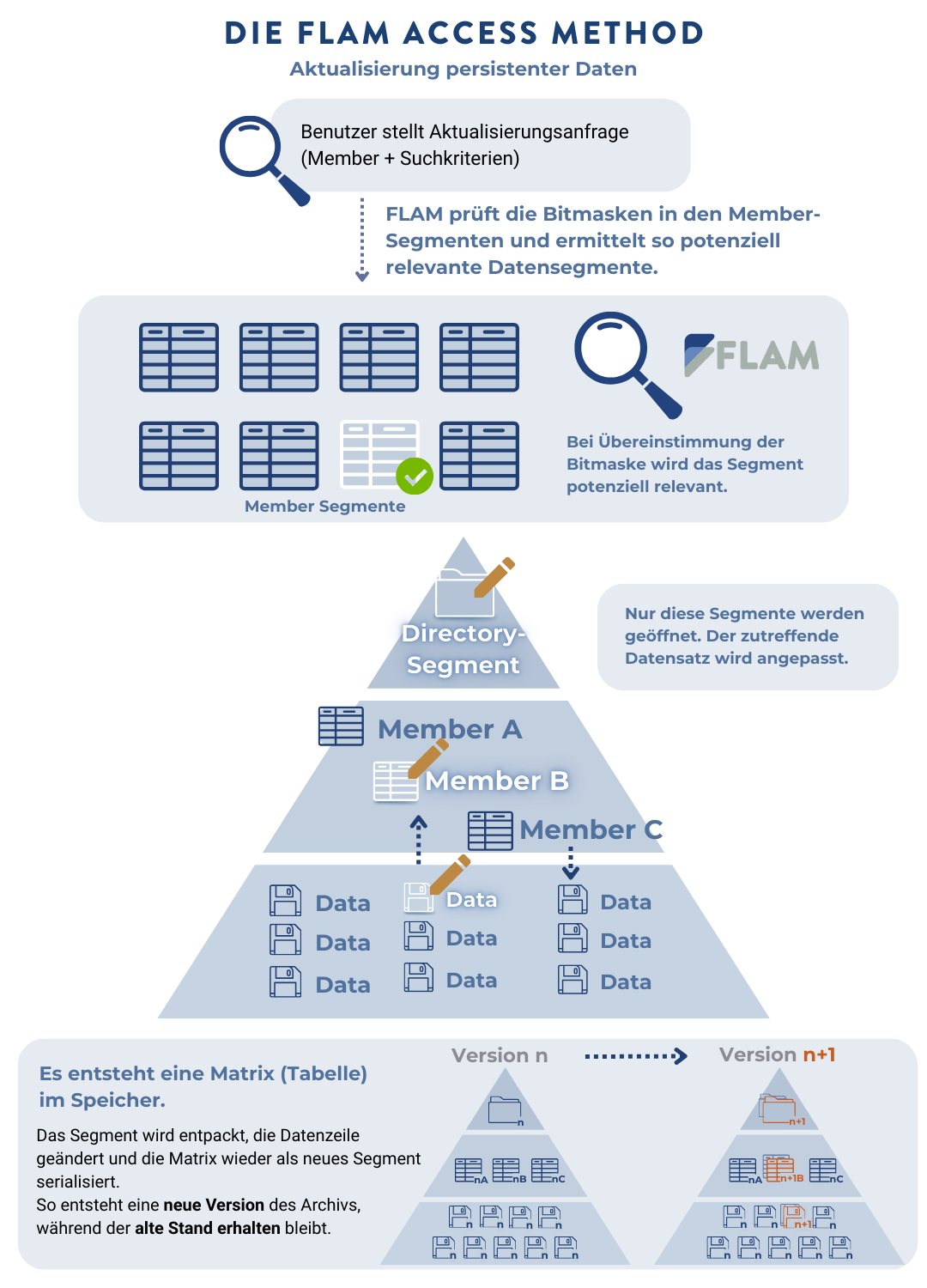
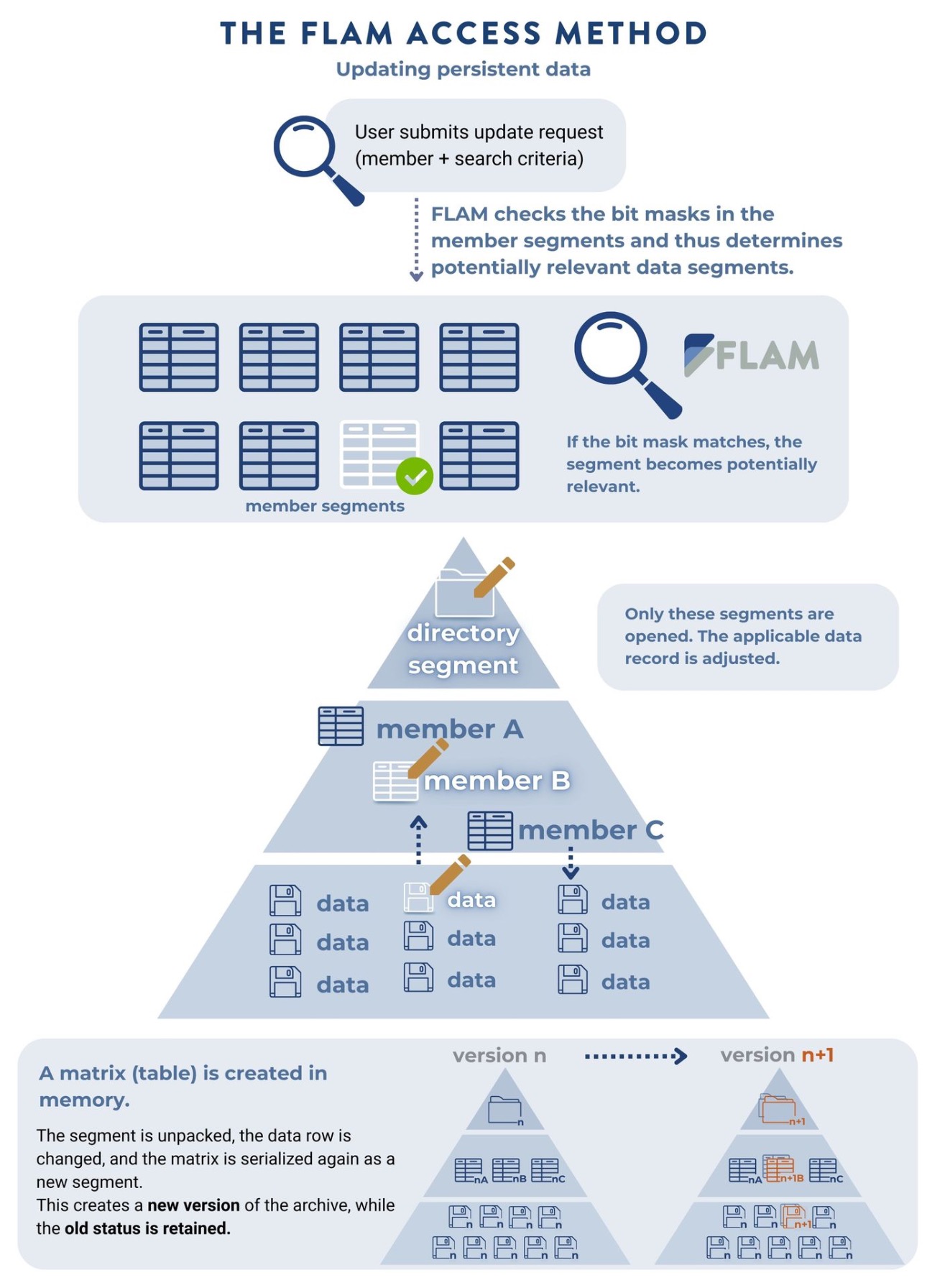
Ongoing inventories in particular require more than traditional archiving. The FLAM Access Method is the technological basis for targeted searching, changing, or supplementing individual records without touching the archive as a whole.
- Individual data records are specifically identified and read using primary keys.
- Only the required segment is read from the archive.
- The section in the memory is decrypted.
- The plain text data is transferred to the application. For example, to edit it.
- The change is saved back to the archive.
- And integrity protection for the new version is restored.
- Unless the previous version is deleted, the old status remains accessible.
APPLICATION EXAMPLE: LOAN DISBURSEMENT IN INSTALLMENTS
WHAT HAPPENS?
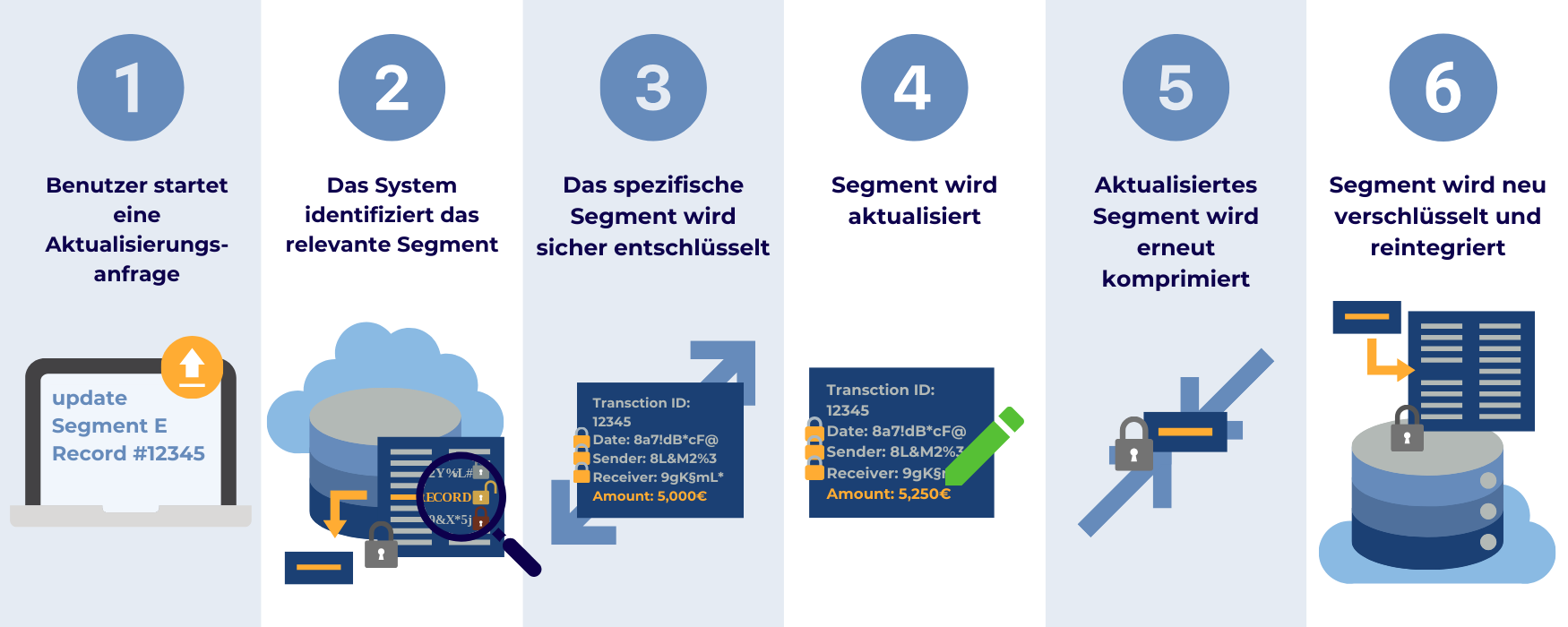
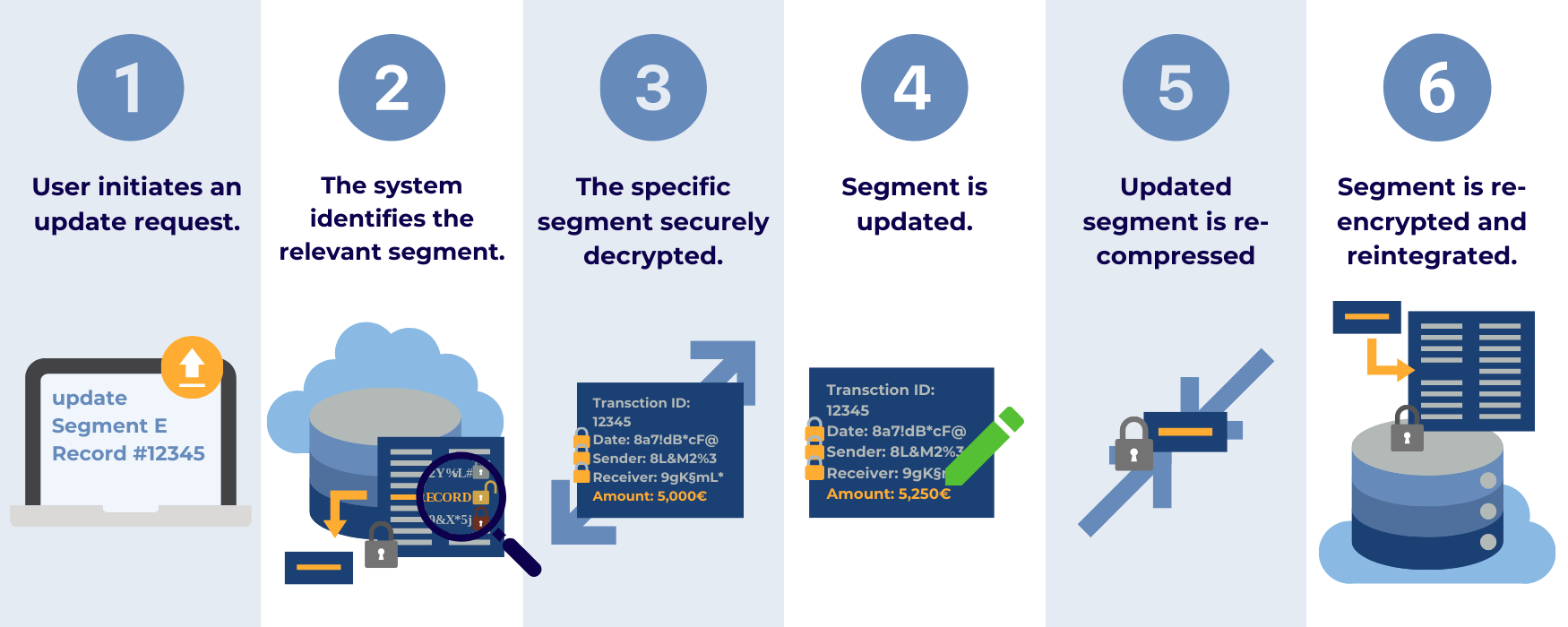
A institution grants a loan to a partner country, e.g., Peru. The total amount is not paid out at once, but in several installments. After each payment, the current status must be documented and archived. The data must remain encrypted and audit-proof.
THE DATA RECORD IS STORED IN THE ARCHIVE.
The original loan record was encrypted, compressed, and segmented before being stored in the FLAM archive.
A NEW PAYMENT IS DUE
A partial amount of the loan is called up. The application identifies the relevant data record using unique characteristics.
FLAM LOADS THE RELEVANT SEGMENT
Instead of opening the entire archive, FLAM loads only the required data block. This is decrypted in the working memory.
THE DATA IS UPDATED
The new partial payment is entered into the existing data record, e.g., as an updated amount or new status.
SAFE RETURN TO THE ARCHIVE
After the change, the data record is recompressed as part of the matrix, encrypted, and provided with integrity protection.
FIND WHAT MATTERS
In many archives, searching is a weak point: it is either slow, imprecise, or not even possible as long as the data is encrypted.
With FLAM, it's different. You can find what you need, even in large, encrypted databases.
PRIMARY KEY AND INDEXING
FLAM stores structured data in such a way that you can find individual records using identification fields, similar to an SQL database with a WHERE clause. For this purpose, entire columns or only parts of columns can be indexed, either case-sensitive or not. A specific set of these indexed columns forms the primary key, which enables updates and inserts.
WILDCARD AND RANGE SEARCH
More complex search patterns are also possible (e.g., with placeholders).
For example, you can extract “all customers with ID 10* in July 2024” without decrypting the entire archive. Here, you have freedom and the solution is backward compatible. If the data you are looking for is not indexed, simply select all segments for that date. Indexing only serves to ensure that not everything has to be read at the end.
FIELD-SPECIFIC FILTERS
To perform an update, you only need to specify the columns that identify the records you want to modify. Furthermore, you only need to specify the fields you want to modify. Especially with SEPA, where a 4-digit number of columns now has to be managed, it is advantageous if only the columns necessary for an update need to be specified.
SEARCH DESPITE ENCRYPTION & COMPRESSION
Access to the indexes is cryptographically secure via Bloom filters and is very high-performance. For such a search, a signature is calculated using a one-way hash function and compared with the segment signatures, thus compiling a subset of segments as the result.
The data itself remains encrypted until it is specifically and only when necessary decrypted locally on site.
FLAM INSTEAD OF DATABASE
Not all data needs to be stored in a database.
Especially for large, long-term stored data sets, such as from billing, subsidy files, or mass transactions, a relational database is too complex and expensive and cannot handle the large amounts of data.
FLAM offers a lean, secure, and cost-efficient alternative.
SAVE RESOURCES
No running database server, no complex memory management.
BETTER SECURITY
The data is not stored in plain text, but permanently encrypted and compressed.
IDEAL FOR STATIC OR UPDATABLE DATA SETS
Data that is rarely changed but often checked or supplemented fits perfectly into FLAM's architecture.
SIMPLER SYSTEM LANDSCAPE
No SQL stack required. FLAM runs via CLI, API, or batch – can be integrated directly into existing pipelines.
FLAM SUPPLEMENTS OR REPLACES DATABASES WHERE:
- Data volumes are large but structures are stable
- Security and auditability are more important than complex relationships
- Archive data still needs to be processed or queried in a targeted manner
For anyone who works with mass data but doesn't want to set up a database management system right away.
YOU DON'T JUST WANT TO ARCHIVE, YOU WANT TO WORK?
FLAM is the solution for companies that want to store large amounts of data securely and use it in a targeted manner.
Whether selective searches, targeted updates, or audit-proof data updates:
With FLAM, you get the most out of your archive.